rova
Swiss scientists unveil crawling robot hand inspired by Addams Family's Thing

Published by Cover Media
24 Jan 2026
Swiss scientists unveil crawling robot hand inspired by Addams Family's Thing
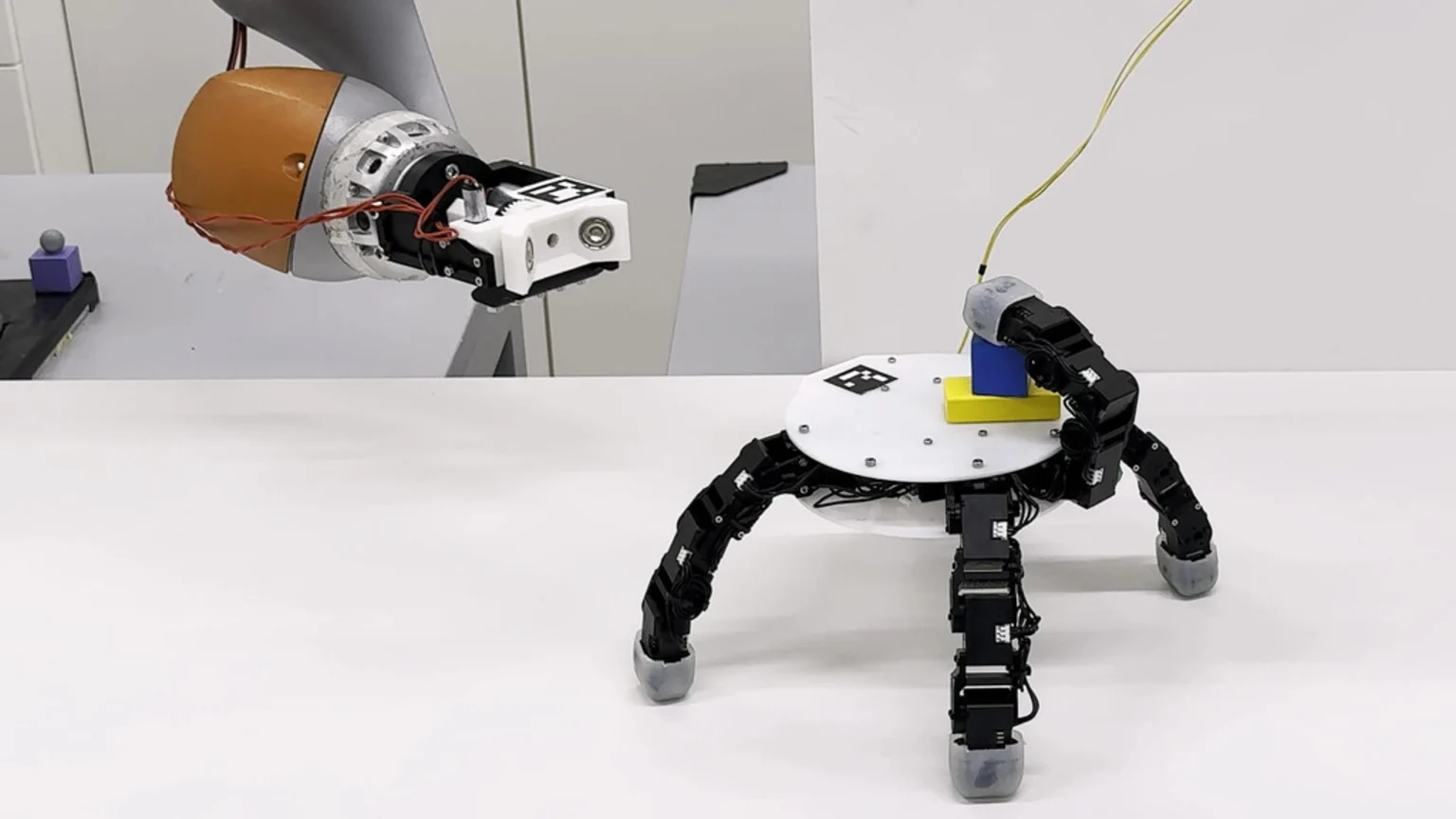
Swiss scientists have developed a robotic hand that can walk off on its own - rather like Thing from The Addams Family.
The creepy creation, developed by researchers at Switzerland's École Polytechnique Fédérale de Lausanne (EPFL), can outperform a human hand's dexterity, thanks to a dual-thumbed design, a reversible palm, and its ability to go walkabout.
The device can support up to six identical silicone-tipped fingers. Rather than having a fixed thumb, any finger can act as one, allowing opposing pairs to form pinches as needed. This removes the asymmetry that limits human hands.
The hand is also reversible, meaning its "palm" and "back" are interchangeable. Perhaps most strikingly, it can detach entirely from its robotic arm and move on its own, crawling in a spider-like fashion to grasp and carry objects beyond the arm's reach.
"Our device reliably and seamlessly performs 'loco manipulation' - stationary manipulation combined with autonomous mobility - which we believe has great potential for industrial, service, and exploratory robotics," says Aude Billard, head of the Learning Algorithms and Systems Laboratory (LASA) in EPFL's School of Engineering.
The team that designed the robot consisted of composed of Billard, LASA researcher Xiao Gao, and Kai Junge and Josie Hughes from the Computational Robot Design and Fabrication Lab.
Although the robot appears futuristic, the researchers say its design was inspired by the natural world.
"Many organisms have evolved versatile limbs that seamlessly switch between different functionalities like grasping and locomotion. For example, the octopus uses its flexible arms both to crawl across the seafloor and open shells, while in the insect world, the praying mantis use specialized limbs for locomotion and prey capture," Billard adds.
Like those organisms, the EPFL hand can move while holding on to objects. It is capable of carrying items under its "palm", on its "back", or both at the same time.
With five fingers, it can reproduce most standard human grasps. With more than five, it can perform tasks that would normally require two hands, such as unscrewing the lid of a large bottle or driving a screw into wood using a screwdriver.
"There is no real limitation in the number of objects it can hold; if we need to hold more objects, we simply add more fingers," Billard says.
The research has been published in the journal Nature Communications.
Published by Cover Media
24 Jan 2026