New Zealand
'Power to the people': How Kiwis could save on bills with new pricing rules
Published by Vijay Varma
01 Jul 2026
Households and small businesses across New Zealand will now have more choice over how they pay for electricity, thanks to new rules coming into effect today.
Energy Minister Simeon Brown announced that the Electricity Authority is now requiring major power companies to offer "time-of-use" pricing plans. These plans reflect the actual, fluctuating cost of generating electricity throughout the day, rather than charging consumers a single flat rate.
The big power companies generate power for different prices at different times of the day, but those same companies usually sell that power to residential and small business customers at one price," Minister Brown said. "That is unfair.
By breaking the day into different pricing zones, the Government aims to make power bills more affordable by giving consumers the flexibility to shift their usage to cheaper periods.
How 'Time-of-Use' pricing plans work
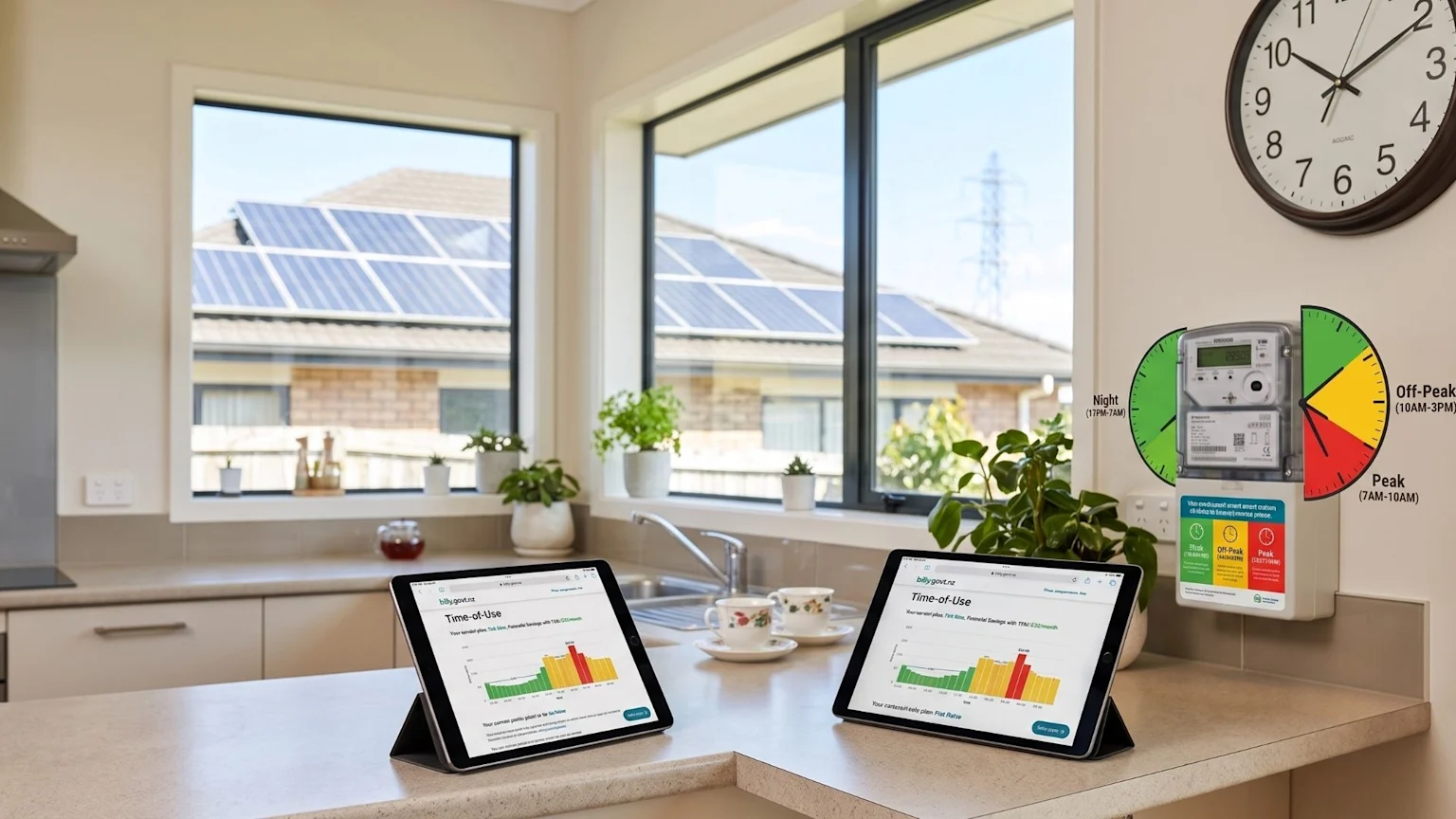
Under the new framework, electricity rates will typically be divided into three distinct daily periods based on demand:
Peak (Highest Cost): 7:00 AM to 10:00 AM and 5:00 PM to 9:00 PM. This is when the grid experiences the highest demand.
Off-Peak / Shoulder (Moderate Cost): 10:00 AM to 5:00 PM and 9:00 PM to 11:00 PM. These are the daytime and late-evening shoulder periods when demand drops.
Night (Lowest Cost): 11:00 PM to 7:00 AM. Prices are at their lowest when overall demand is minimal.
By moving power-heavy tasks like running the dishwasher, doing the laundry, or charging an EV to off-peak or overnight hours, consumers can significantly lower their overall power bills.
Brown told rova, “These rules are about ensuring that customers have choice about when they use power in order to make their power bills more affordable.”
It's power to the people. That's what it's about - giving people choice.
"Not everyone will be able to necessarily shift the the time that they use the power in their in their home, but giving people choice gives them the ability to think about it," he added.
Major boost for homes with solar and batteries
The policy shake-up is also designed to make home solar and battery systems far more financially attractive.
The new rules require power companies to apply time-of-use pricing to the electricity that households export back into the grid. This means residents who send solar power back to the system during high-demand peak times will be rewarded with much higher financial returns.
This change builds on recent grid upgrades that doubled the household export limit from 5kW to 10kW.
The broader energy plan
Minister Brown emphasised that while there is no overnight fix to energy costs, these regulations are a practical step toward the Government's goal of abundant, affordable, and reliable energy.
"Introducing time-of-use plans which can make power cheaper, or even free, during off-peak times, is one of those steps," Brown said.
How to check if you can save
Consumers are encouraged to contact their current electricity provider to see what new plans are available.
Alternatively, you can visit billy.govt.nz - the Electricity Authority’s free price comparison and switching tool - to calculate realistic savings and check if you are getting the best deal for your household.
Published by Vijay Varma
01 Jul 2026