rova
New images reveal Cat's Eye Nebula in astonishing and beautiful detail

Published by Cover Media
05 Mar 2026
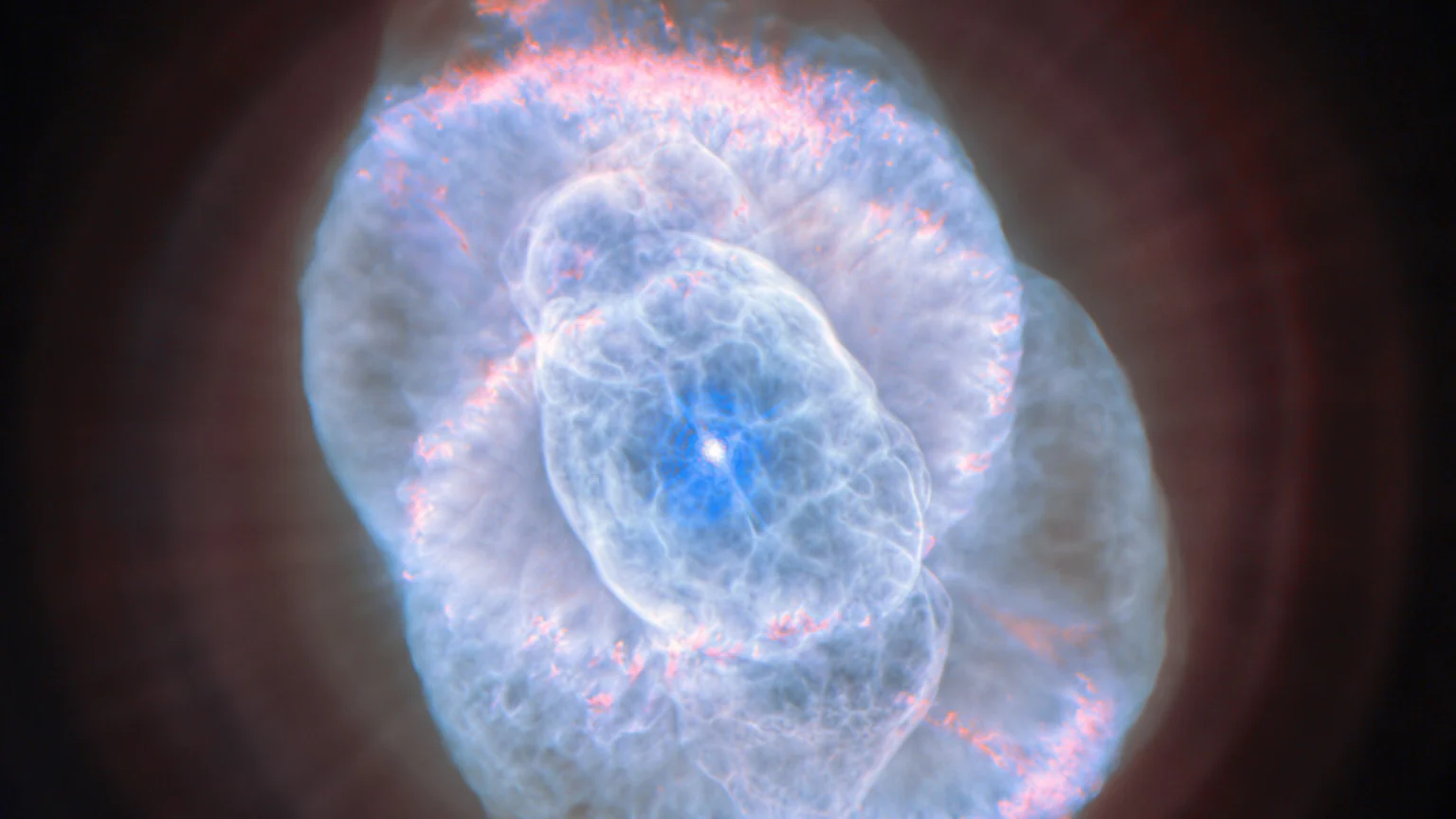
New images has been revealed of one of the sky's most beautiful sights - the Cat's Eye nebula - in extraordinary detail.
The Cat's Eye Nebula, also known as NGC 6543, has fascinated astronomers for decades because of its intricate, layered appearance.
Despite their name, planetary nebulae have nothing to do with planets. The term dates back to early telescopic observations, when their rounded shapes resembled distant worlds. In reality, they are clouds of gas expelled by stars nearing the end of their lives. It was the Cat's Eye Nebula itself that helped establish this fact in 1864, when astronomers studying its light spectrum identified emissions from individual molecules - a clear signature of gas rather than stars or galaxies.
The latest images combine observations from the NASA/ESA Hubble Space Telescope and ESA's Euclid, revealing its striking complexity n unprecedented detail.
Although Euclid was designed to map the distant Universe, it also captures nearby objects during its deep imaging surveys. In its wide view of the Cat's Eye Nebula, taken in visible and near-infrared light, bright arcs and filaments at the centre sit within a halo of colourful gas fragments streaming away from the dying star.
Astronomers believe this outer ring was expelled earlier in the star's evolution, before the central nebula formed. The scene is set against a background crowded with distant galaxies, illustrating how nearby cosmic landmarks and the farthest reaches of the Universe can appear together in modern surveys.
Zooming in further, Hubble's high-resolution images reveal the turbulent heart of the nebula. Concentric shells, high-speed jets and dense knots of gas are visible, shaped by powerful shock interactions. The resulting structures appear almost surreal in their detail.
Scientists think these features preserve a cosmic 'fossil record' of episodic mass loss from the star as it approached the end of its life, offering clues to its final evolutionary stages.
By combining Hubble's sharp focus with Euclid's sweeping view, astronomers are able not only to appreciate the nebula's delicate structure, but also to place it within the wider Universe explored by both missions. Together, the observations provide a vivid portrait of NGC 6543, highlighting the interplay between the death of a star and the vast cosmic environment beyond it.
Published by Cover Media
05 Mar 2026