Opinion
Labour’s Transport Freebie Does Not Add Up
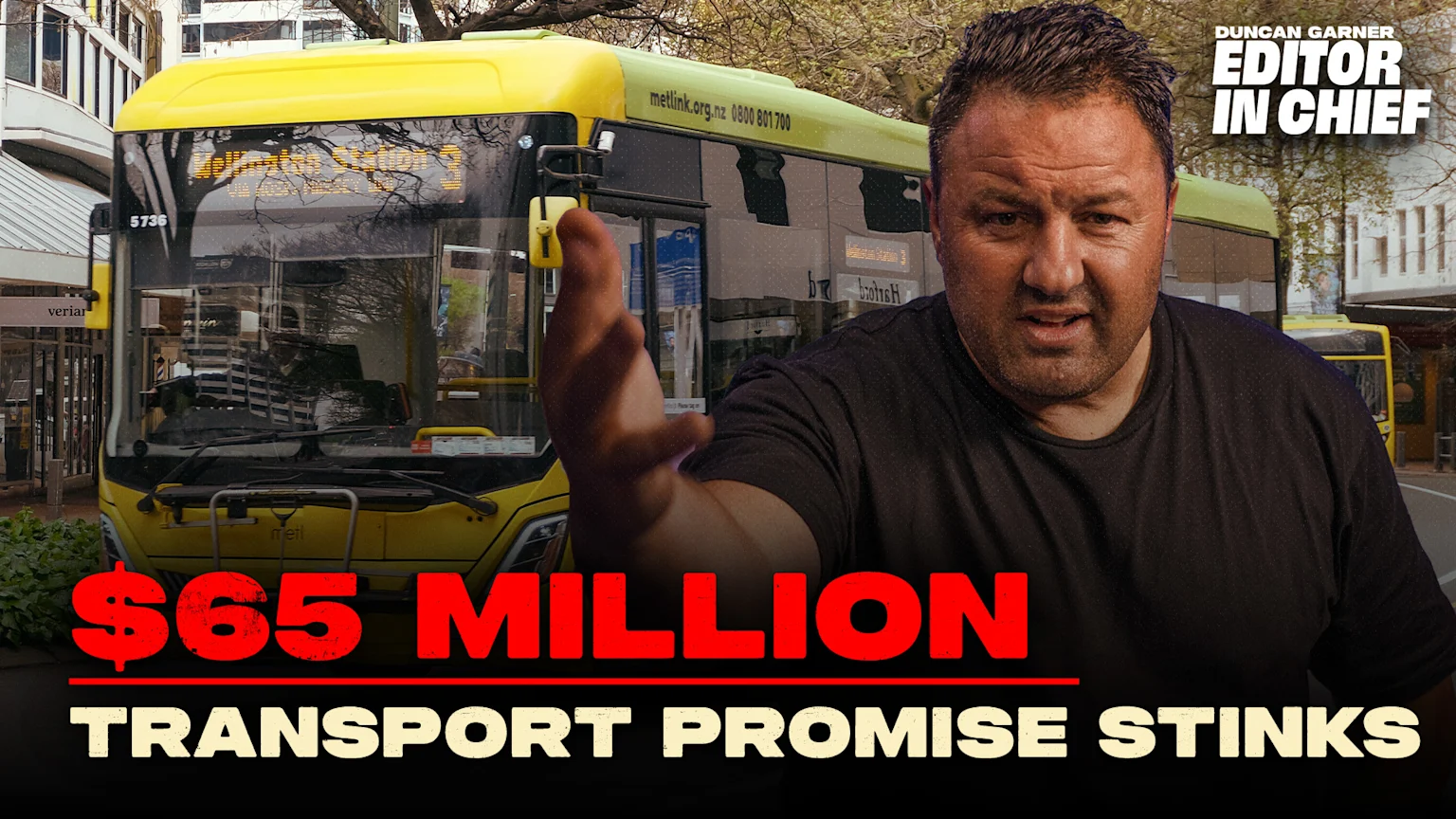

Published by Duncan Garner
11 Jun 2026
Labour wants voters to believe 1.3 million Kiwis can save big while taxpayers barely notice the bill. That is not policy, it is magic.
Chris Hipkins has a numbers problem. A serious one.
Labour’s first big cost-of-living promise is a public transport cap of $20 a week. Sounds tidy. Sounds generous. Sounds like something cooked up to grab a headline before anyone had time to ask the obvious question.
How does a policy that supposedly benefits 1.3 million New Zealanders, with some saving up to $1,200 a year, cost only $65 million?
That is the bit Labour cannot explain. Not properly. Not convincingly. Not without sounding like it is hoping voters will be too busy worrying about groceries, mortgages and power bills to notice the hole in the middle of the pitch.
Because if 1.3 million people really are saving anything close to what Labour is advertising, the cost does not sit at $65 million. It rockets. If large numbers of commuters are saving hundreds or thousands a year, somebody pays. The bus companies do not absorb it out of goodwill. Train operators do not wave away revenue losses because Chris Hipkins has found a slogan.
Someone picks up the tab. That someone is the taxpayer.
Labour says this is about easing pressure on families. Fine. People are under pressure. Nobody sane denies that. But cost-of-living policy still has to add up. You do not get to throw around big savings, slap a tiny price tag on the side, and call it responsible.
The questions are simple. How many people will actually hit the cap? How many extra trips is Labour assuming? What is the revenue loss in Auckland, Wellington and Christchurch? What happens to smaller networks? How many of the 1.3 million will save a meaningful amount, and how many will save loose change?
These are not nerdy accounting questions. They are the policy.
If the modelling is solid, release it. If the assumptions are robust, show them. If the $65 million figure is real, Labour should have no problem putting the workings in front of the public.
But it has not. Instead, we get the usual campaign trick. Big headline. Soft promise. Warm language. Then, when the arithmetic gets tested, everything suddenly becomes a fog of averages, assumptions and political spin.
New Zealanders have seen this movie before. Big promises before an election. Then the details arrive later, usually with a much bigger invoice attached.
And there is another problem. Labour says the money comes from the National Land Transport Fund. That fund is already under pressure. So what gets cut? Road maintenance? Other transport projects? Regional work? Safety upgrades?
Labour cannot just pretend there is a spare drawer marked “free bus money”.
This is the problem with opposition politics when desperation creeps in. You start chasing applause instead of credibility. Labour needed a clean, disciplined, properly costed first move. Instead, it has released something that looks rushed, light and far too clever by half.
A $20 weekly cap might be popular. It might even be worth debating. But popularity is not proof. A slogan is not a costing. And a policy that depends on voters not doing basic maths is not a serious plan.
Labour has one job right now: prove it can be trusted with the books again.
This does the opposite.
Listen to the full episode:
Published by Duncan Garner
11 Jun 2026