Technology
How the 'K-Pop Playbook' is Launching India's New Era of Pop Supergroups
Published by Ketan Kumawat
03 Jul 2026
For decades, if an Indian teenager wanted to experience the thrilling obsession of being a music "stan," they had to look across oceans. They looked to the West for One Direction or to South Korea for BTS and Blackpink. Domestically, India's music charts were completely monopolized by Bollywood playback singers or solo indie artists. There were no local squads to obsess over, no complex choreography to replicate in front of the bedroom mirror, and no "who is your favorite member" debates in the school canteen.
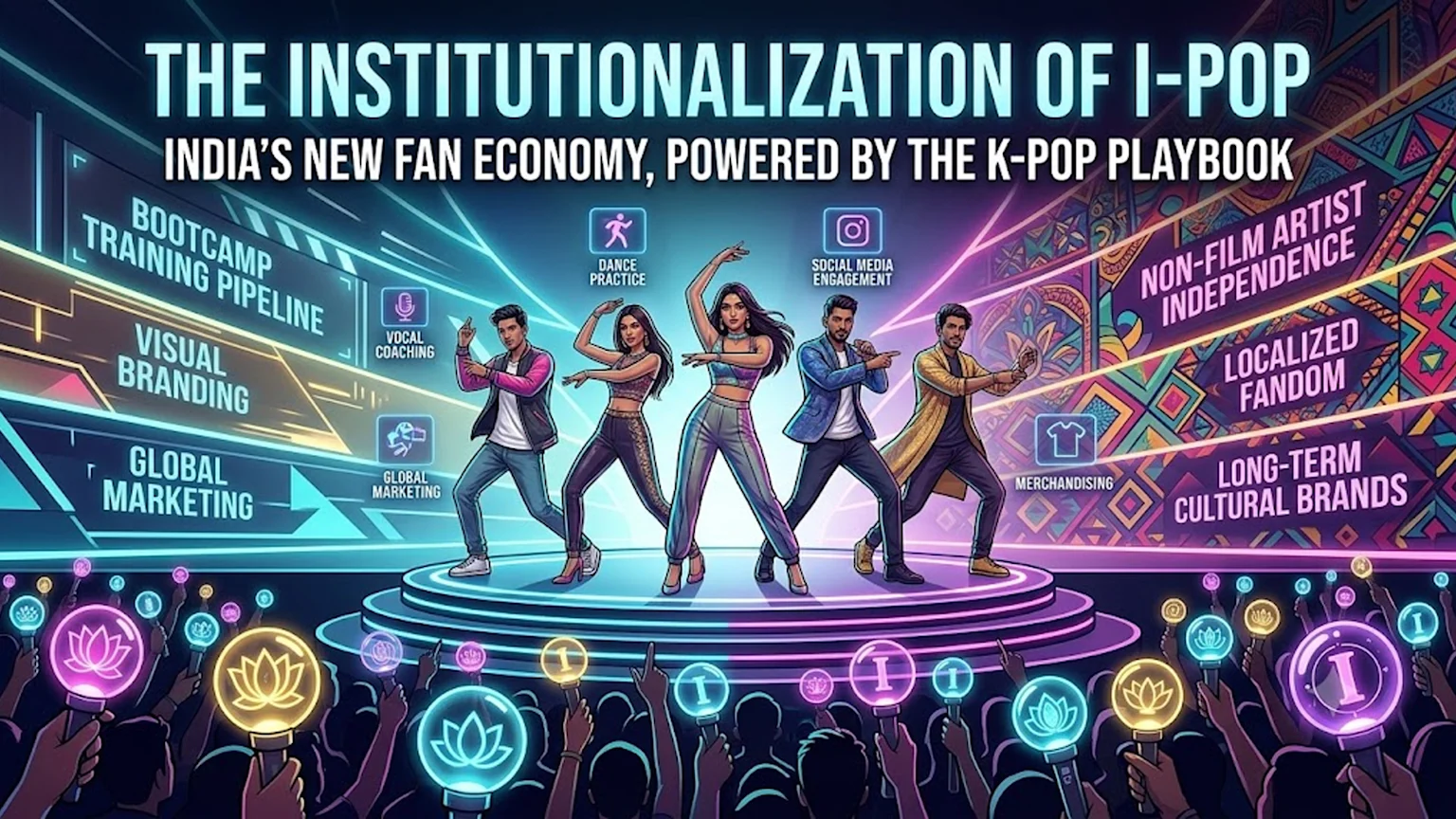
That narrative has completely broken down. The independent Indian music landscape—frequently heralded as "I-Pop"—has transitioned from casual, one-off viral singles into a highly institutionalized machinery. Major music labels and global powerhouses are officially deploying the international pop playbook to discover, train, and market homegrown Indian supergroups as long-term cultural brands.
The Bootcamps and the Machinery
The core of this revolution lies in a complete overhaul of how music groups are manufactured. It is no longer about a few friends jamming in a garage and hoping to get discovered. Today’s I-Pop groups are the product of rigorous talent pipelines, nationwide digital auditions, and exhausting training regimens designed to turn raw talent into polished, stage-ready idols.
The global scale of this trend became undeniable when South Korean entertainment giant HYBE—the multi-billion-dollar behemoth behind BTS—announced the launch of its official branch in India. The company’s explicit goal is to export its full-stack K-pop idol system directly to the Indian subcontinent, discovering local talent and applying their strict training, visual creation, and marketing pipelines to create a new breed of hyper-local intellectual properties.
Meeting the New Icons: W.i.S.H. and OutStation
Leading the charge in this brave new musical world are a handful of trailblazing groups that are successfully capturing the hearts of Gen Z. Front and center is W.i.S.H. (an acronym for World Inka Stage Hai), a four-member girl group comprising sisters Ri and Sim, alongside Zo and Suchi. Created and mentored by hit music director Mikey McCleary in collaboration with Sony Music India, the group made waves with their explosive debut track Lazeez and their album Sweetburn. With sharp choreography and a vibrant mix of Hindi and English lyrics, they have broken a decades-long drought of mainstream Indian girl groups.
On the boy band front, OutStation has quickly become a national phenomenon. Brought together by four-time Grammy-nominated songwriter-producer Savan Kotecha and Visva Records, the five-member group features boys from entirely different corners of India, including Goa, Delhi, Prayagraj, and Hyderabad. Before releasing hits like Aaj Kal, the boys endured a grueling, highly monitored bootcamp in Goa where their days ran from 7 AM to 10 PM, packed with vocal drills, intense dance rehearsals, and media training. To solidify their bond, the bandmates now live together in a shared apartment in Mumbai, constantly jamming and practicing their craft.
"For the longest time, if you wanted a band experience, you had to look outside India," producer Savan Kotecha noted on the shift. "But now, young people want to see themselves reflected in the music they love."
Deconstructing the "Fandom Economy"
What truly separates these modern projects from the indie bands of the past is the intentional creation of a dedicated fandom economy. Major music labels are realizing that a pop group isn't just selling audio tracks to streaming platforms; they are selling identity, fashion, and lifestyle.
For the first time, Indian music fans are generating localized "fancams" (stylized video edits of individual members), trading digital photocards, and defending their "biases" (their ultimate favorite band member) on social media. OutStation’s rapidly growing fanbase has even formally adopted the moniker "Passengers," showcasing a tight-knit community dynamic that mirrors the fiercely loyal fan cultures found in Seoul or Los Angeles.
Authentically Desi, Globally Built
While the structure and marketing strategies are heavily inspired by global systems, the music itself remains fiercely local. Rather than merely imitating foreign pop styles, these groups are intentionally weaving Indian cultural elements into their Western-influenced tracks. For instance, the members of OutStation frequently practice traditional Indian classical riyaaz alongside Western vocal harmonies to unlock unique tonal ranges.
By prioritizing long-term visual storytelling, high-octane live performances, and deeply personal fan interactions over the short-lived highs of Instagram Reel algorithms, I-Pop is building an infrastructure that can last. While mainstream Bollywood music continues to rely heavily on safe formulas and corporate remixes, the independent group scene is taking the real creative risks—and defining exactly what modern Indian pop culture looks like on the global stage.
Published by Ketan Kumawat
03 Jul 2026