Technology
How AI is Moving from Your Screen to the Fabric of Daily Life
Published by Ketan Kumawat
01 Jul 2026
Remember when using artificial intelligence meant pulling up a specific app, typing a carefully crafted prompt, and waiting for a clever paragraph or a flashy image? That era is quickly drawing to a close. We are witnessing a massive pivot: AI is shifting from an external tool you have to actively manage to an invisible infrastructure—running quietly in the background of a standard Tuesday afternoon.
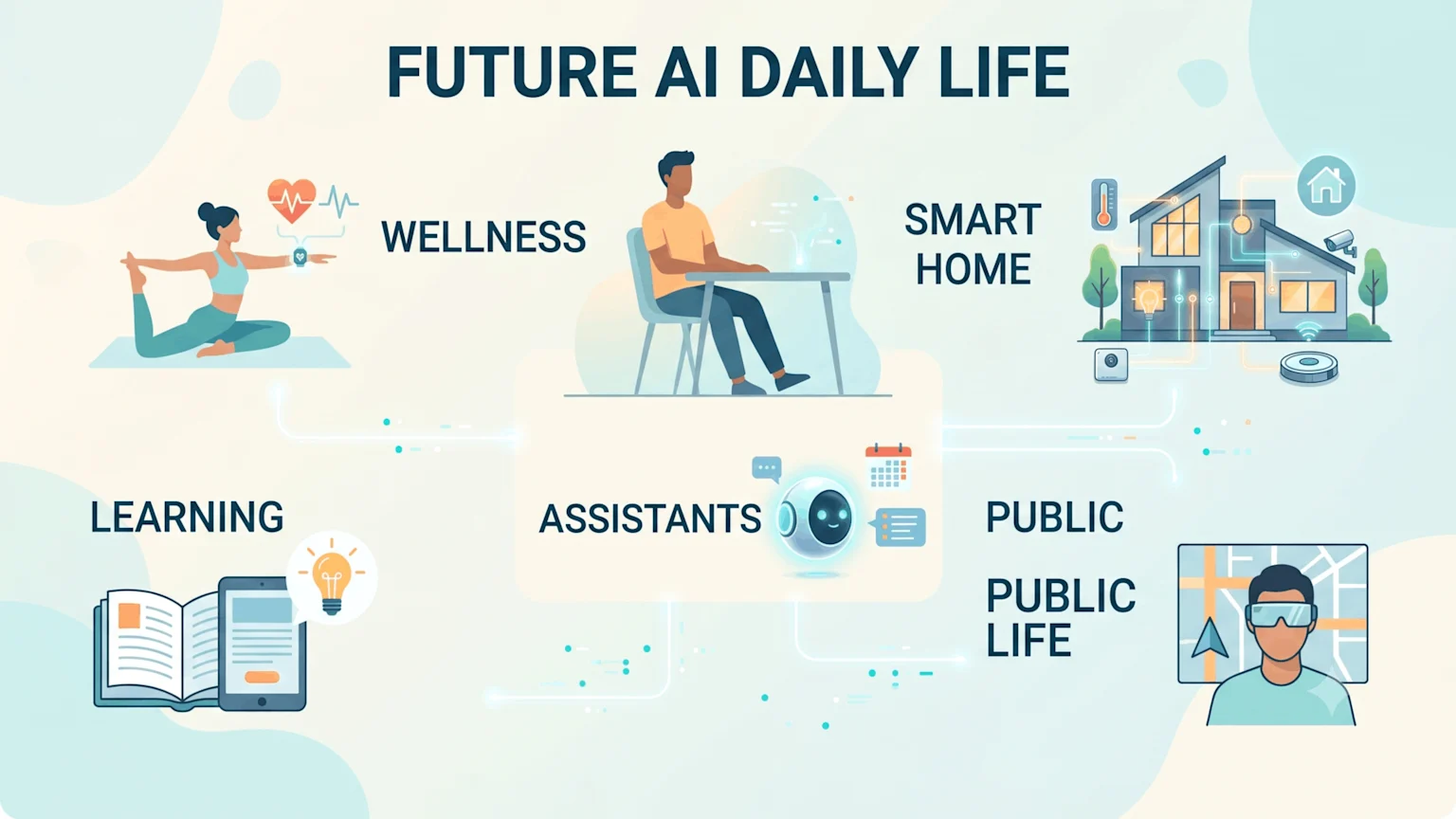
The future of AI in regular life isn't about humanoid robots doing your dishes (at least, not yet). It is about the gradual elimination of daily friction. Here is how AI is weaving into the fabric of ordinary routines, transforming the mundane into something entirely seamless.
The Ambient Home: From "Smart" to Intuitive
For years, a "smart home" just meant you could yell at a speaker to turn off the lights, or accidentally trigger your robot vacuum from the office. The next phase of AI shifts the burden of intent from you to the environment itself.
Instead of waiting for your command, a future AI-integrated home uses contextual awareness to anticipate your needs:
Dynamic Environments: Your living space can learn your biometrics through your wearable devices, automatically adjusting temperature, lighting, and acoustic background noise to lower your cortisol levels after a stressful day.
Predictive Maintenance: You won't have to wait for your refrigerator to break down or your HVAC to fail. Internal AI diagnostic sensors identify mechanical wear-and-tear early, automatically scheduling a repair technician or ordering a replacement part before a glitch even occurs.
Smart Nutrition: Your kitchen inventory can sync with your health goals, suggesting recipes based on what's nearing its expiration date while subtly factoring in your current dietary needs or fitness targets.
The Death of 'Digital Chores'
Think about how much of your day is spent navigating modern digital friction: scheduling appointments, disputing a mysterious charge on a bill, booking flights, or sorting through endless clutter in your inbox.
The future of daily life belongs to AI Agents—digital assistants capable of executing multi-step workflows across different apps on your behalf.
The Future Scenario: Instead of spending an hour comparing flights, hotels, and calendar openings for a weekend trip, you will simply tell your device: "Book a weekend getaway to Chicago next month that fits my budget and doesn't overlap with my family calendar." Your agent will negotiate with other software systems, cross-reference your personal schedule, optimize for your preferred airline rewards, and present you with a finalized itinerary. You become the curator of your life, while AI handles the administrative heavy lifting.
Proactive Healthcare, Right on Your Wrist
Right now, wearables track where you go and how fast your heart beats. In the coming years, the intersection of AI and personal health will pivot sharply from tracking historical data to predicting future outcomes.
Symptom Triage: Instead of typing your symptoms into a search engine and convincing yourself of a worst-case scenario, personalized medical AI models trained on massive, high-quality biomedical datasets will offer highly accurate, conversational health triage.
Early Intervention: Continuous, passive monitoring of your speech patterns, gait, heart rate variability, and sleep cycles will allow AI to flag micro-changes. It can warn you of an impending illness days before you feel symptoms, or alert your doctor to subtle cardiovascular anomalies long before they turn into emergencies.
Hyper-Personalised Lifelong Learning
Education won't stop when you graduate, and it won't be confined to a rigid, one-size-fits-all model. Whether you are a child trying to understand fractions, a young professional trying to learn a coding language, or a retiree picking up the guitar, AI will serve as a 24/7 patient, bespoke tutor.
It adapts instantly to your learning speed, matches your specific learning style (whether you prefer visual aids, conversational breakdowns, or text), and pivots its strategy the moment it detects you are getting frustrated.
The Big Picture: Making Room for What Matters
There is a common anxiety that a highly automated future will make our lives cold, detached, and overly robotic. But the reality of AI in regular life is likely the exact opposite.
By automating the repetitive, high-friction, and exhausting micro-tasks of modern existence—the scheduling, the searching, the data sorting—AI doesn’t take away our humanity. It gives us our time back. The future of AI isn't about living inside a sci-fi movie; it's about having the mental bandwidth to step away from our screens, cook a real meal, spend time outside, and focus on the human connections that machines can never replicate.
Published by Ketan Kumawat
01 Jul 2026